
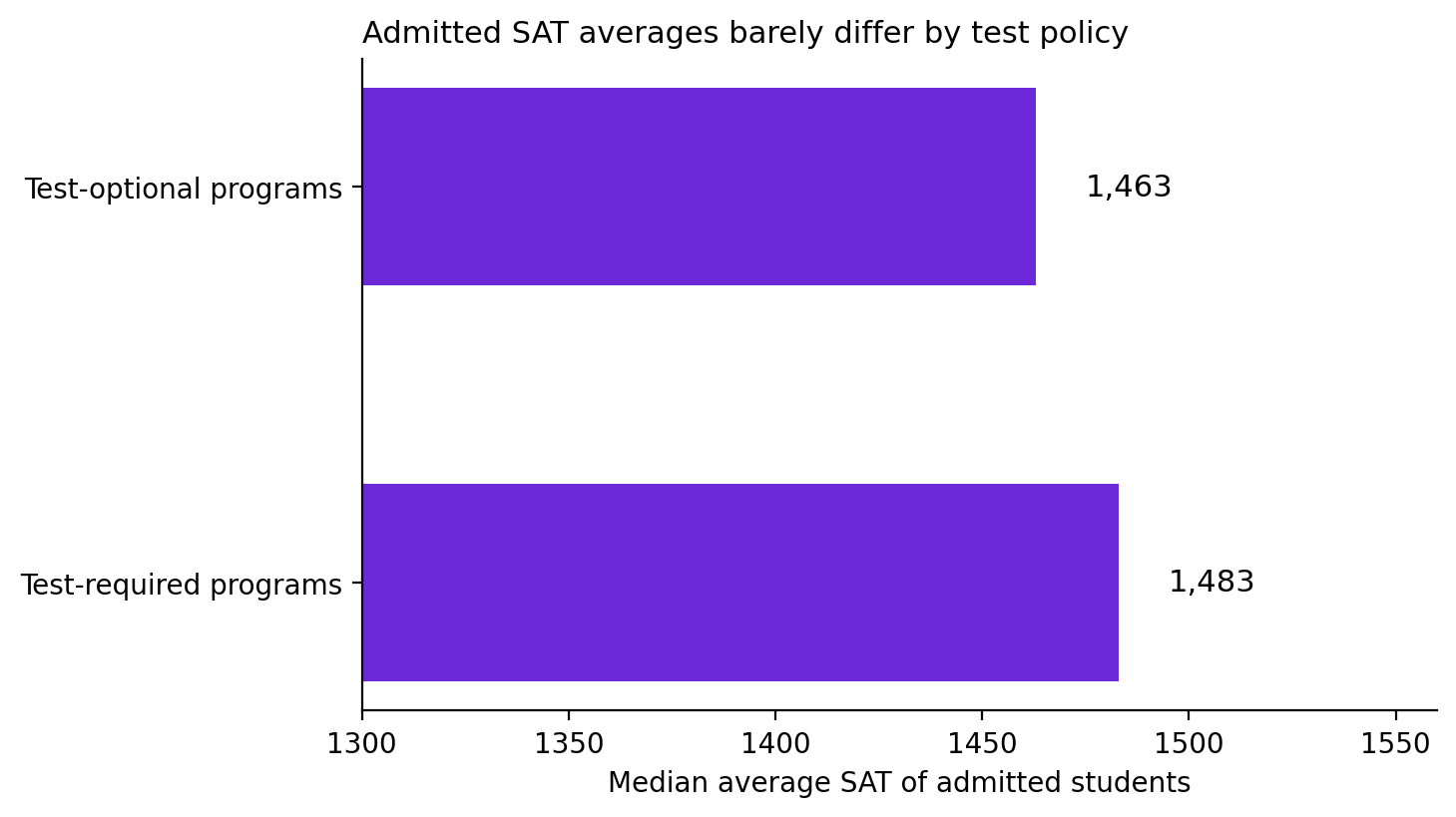
Test-optional is now the default setting of American admissions. Of the 140 programs in this database that state a test policy, 92 (66%) are test-optional, and among undergraduate programs the share is 80 of 100. The natural expectation is that dropping the test requirement lowers the scores of the students who arrive. The admitted classes disagree: the median average SAT at test-optional programs is 1,463, against 1,483 at the programs that still require tests, a gap of 20 points on a 1,600 scale. The ACT tells the same story, 32.5 against 33.3.
| Group | Programs | Median admitted SAT | Median admitted ACT |
|---|---|---|---|
| Test-optional | 92 of 140 stating a policy | 1,463 (70 reporting) | 32.5 |
| Test-required | 48 of 140 | 1,483 (20 reporting) | 33.3 |
| Undergraduate programs | 80 of 100 test-optional | Graduate programs state policies less often | |
Optional changed the submission, not the class
The mechanism is selection, and it runs in both directions. Students with strong scores still submit them, because a good score helps; students with weak scores withhold, and the ones admitted without scores tend to carry the grades and records to compensate. Meanwhile the published averages at optional schools are computed only from submitters, which keeps the number high. The result is a policy that widens the applicant pool without diluting the enrolled profile, which is precisely why universities adopted it and why so few have gone back.
What an applicant should do with this
Read test-optional as a threshold rule, not a free pass. If your score sits at or above the program's admitted average, submit it: at an optional school that number still separates you from the pool. If it sits well below, the option exists for you, but the rest of the file has to do the work the score would have done, because the class you are joining was admitted at 1,463 either way. Optional removed the obligation. It did not remove the standard.
Counts from the SOPExpert database of 221 program requirements at 182 universities, verified September 10-11, 2026. Admitted averages are the programs' published figures for recent entering classes.